This is the prime window for multi-toned gradients. A single tree crown might display a stunning blend of summer green, soft peach, glowing amber, and deep violet-red all at once.
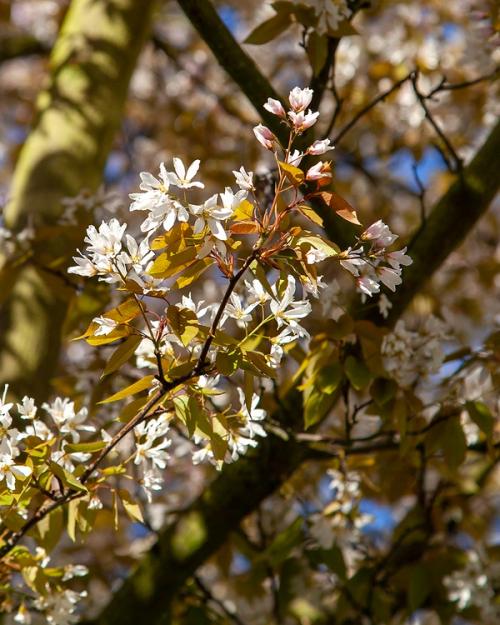
The Amelanchier genus contains several species which can be found planted in public places and private gardens in the UK. Street trees tend to be A. lamarckii, often grown as standards, that is trees with a single trunk. In gardens, multi-stemmed trees are more common. All the Amelanchiers are commonly known as juneberry or snowy mespil, and they are quite similar in appearance.
At the start of April, they produce masses of delicate white flowers which some might confuse with cherries. Unlike cherries though, Amelanchier species have small leaves and smooth, grey bark. When the flowering period conicides with cool weather, the blossom can last for some time, but if it is warm and sunny, it tends to be very fleeting. So, this is a tree for a gloomy April!
In June, the tree produces small berry-like fruit which is much appreciated by birds and squirrels, and in the autumn, leaves can take on spectacular red and orange hues.

Amelcnchiers are small flowering trees and shrubs with white spring flowers and small berries developing in summer.
The Amelanchier genus contains several species which can be found planted in public places and private gardens in the UK. Street trees tend to be A. lamarckii, often grown as standards, that is trees with a single trunk. In gardens, multi-stemmed trees are more common. All the Amelanchiers are commonly known as juneberry or snowy mespil, and they are quite similar in appearance.
At the start of April, they produce masses of delicate white flowers which some might confuse with cherries. Unlike cherries though, Amelanchier species have small leaves and smooth, grey bark. When the flowering period conicides with cool weather, the blossom can last for some time, but if it is warm and sunny, it tends to be very fleeting. So, this is a tree for a gloomy April!
In June, the tree produces small berry-like fruit which is much appreciated by birds and squirrels, and in the autumn, leaves can take on spectacular red and orange hues.
Amelcnchiers are small flowering trees and shrubs with white spring flowers and small berries developing in summer.
The Amelanchier genus contains several species which can be found planted in public places and private gardens in the UK. Street trees tend to be A. lamarckii, often grown as standards, that is trees with a single trunk. In gardens, multi-stemmed trees are more common. All the Amelanchiers are commonly known as juneberry or snowy mespil, and they are quite similar in appearance.
At the start of April, they produce masses of delicate white flowers which some might confuse with cherries. Unlike cherries though, Amelanchier species have small leaves and smooth, grey bark. When the flowering period conicides with cool weather, the blossom can last for some time, but if it is warm and sunny, it tends to be very fleeting. So, this is a tree for a gloomy April!
In June, the tree produces small berry-like fruit which is much appreciated by birds and squirrels, and in the autumn, leaves can take on spectacular red and orange hues.
American Sweetgums could be mistaken for one of the Maple species because they have pointed, five-lobed leaves.
But their seeds are held in balls, unlike the winged 'samara' or helicopters of the Maples.
Sweetgums have great autumn colours which you can see very late into the season and some trees may retain a few leaves right through the winter in mild years.

